Their clothing takes heavy abrasion on the shoulders, gets snagged on fittings and has to work with a harness and a tool belt. Here is how scaffolding firms usually kit out their gangs.
Shoulders, belts and harnesses
Carrying tube on the shoulder wears through a cheap top quickly. Heavier polycotton sweatshirts and workwear T-shirts hold up better than thin fashion cotton. Some scaffolders wear a shoulder pad, but the top underneath still takes the rub.
A scaffolder's belt carries a scaffold spanner, podger and level, and many wear a harness for some or all of the job. Jackets need to sit neatly under or over the straps, so avoid long, loose coats. Trousers need strong belt loops that will not tear out.
No loose ends
Anything that hangs can catch on a coupler or a board end. Hoods with long drawcords, open zips and dangling lanyards are a nuisance and a risk. Choose fitted layers and tuck cords away. Gloves with a good grip help when handling wet or frosty tube. Lanyards for passes and phones should be breakaway types or tucked inside a zipped pocket, so nothing pulls you off balance when it catches.
Footwear for boards and ladders
Many scaffolders prefer a lace-up safety boot with good ankle support over a rigger boot, because they spend the day stepping across boards and climbing. A slip-resistant sole matters on wet or icy boards. Choose safety footwear to EN ISO 20345 that matches your risk assessment; S3 is a common choice for outdoor scaffolding. Rigger boots can slip at the heel when climbing, which is one reason many gangs avoid them.
Visibility on the yard and the job
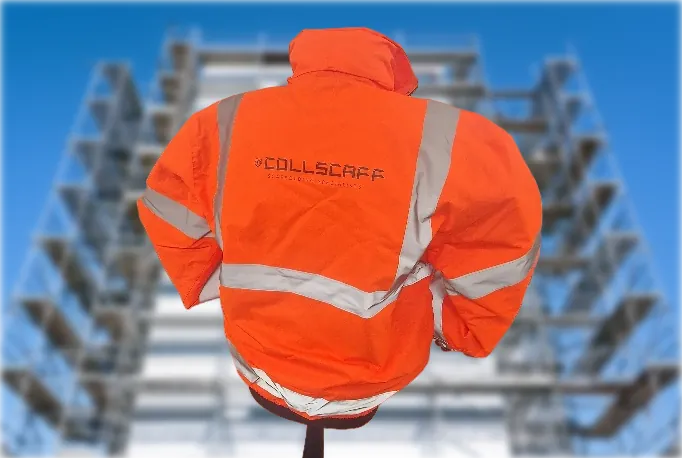
Scaffolders load and unload wagons in the yard and on the road outside a job, often next to traffic. Hi-vis is usually required on site and when working near vehicles. Check the site rules for the class needed. A hi-vis T-shirt or polo saves wearing a vest over the top of everything, which can snag. Yard staff loading wagons with a forklift need it just as much as the gang on the job.
Where to put your logo
Scaffolding firms are some of the most recognisable on any street, and the gang's clothing should match the banners on the lifts. Print the firm's name across the back of T-shirts and hi-vis, because people look up at scaffolders from below and behind. Embroider a left chest logo on sweatshirts and gilets for a lasting mark. On hi-vis, logos go only on the fluorescent fabric and never over reflective tape; a large print can reduce the compliant area.